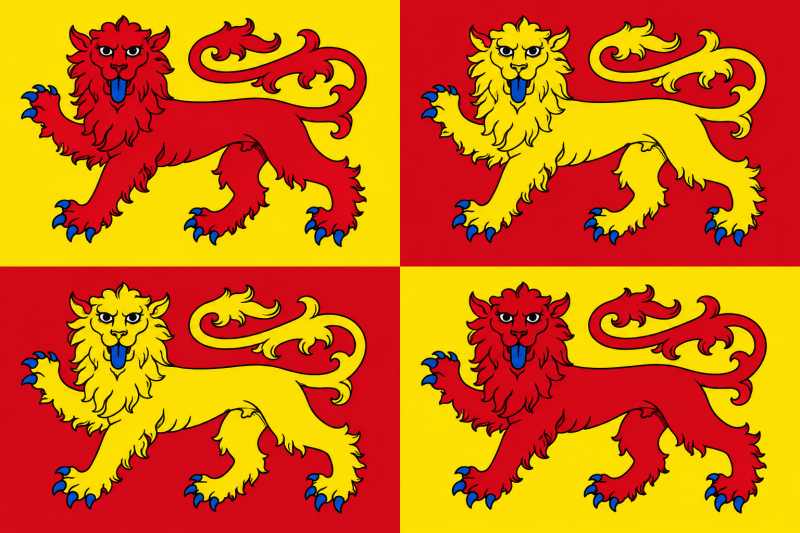
We’ve just completed two pieces for BBC Countryfile Magazine – one on the great Owain Lawgoch who fought for the French against English forces, during the Hundred Years’ War – and the other about Prince Madoc, who was said to have discovered North America (a myth!).
Owain Lawgoch (“Owain of the Red Hand”) was the great-nephew of Llywelyn ap Gruffudd and the last direct heir of the royal house of Gwynedd, who is said to have been born and reared in Tatsfield, Surrey… he then headed to France, where he became a respected mercenary captain fighting for the French crown against the English in the Hundred Years’ War.
He openly claimed the title Prince of Wales, and in 1372 King Charles V of France funded a fleet for him to invade Wales. The expedition got as far as Guernsey before he was recalled to support France’s Castilian allies, and a later attempt in 1377 also came to nothing.
Seeing him as a real threat, the English hired a Scottish agent, John Lamb, to assassinate Owain in 1378, during the siege of Mortagne-sur-Gironde. With him the senior line of Gwynedd died out, though Welsh folklore kept him alive as a sleeping hero waiting in a cave to return and free Wales from English oppression.
And Owain wasn’t the only Welsh prince to fight English colonialism by working with France… the Gwynns of Llansteffan lost a family member fighting the English at Agincourt… Henry Don of Cydweli worked with the French to attack the English crown around Wales’s and England’s coasts… Glyndwr worked very closely with France too… not remembered as much as it should be! That spirit of resistance.
Prince Madoc (Madog ab Owain Gwynedd) is a figure of Welsh legend, said to be a son of Owain Gwynedd, King of Gwynedd, though no contemporary record proves he existed. According to the story, after his father’s death in 1170 his brothers fought bitterly over the succession, so Madoc sailed west from Wales to escape the strife.
He reportedly found a rich new land across the ocean, came back to gather settlers, and set out again with several ships, never to return. The tale was promoted in Elizabethan England, notably by John Dee and Richard Hakluyt, as a way to claim that Britain had reached America before Spain.
Later rumours of Welsh-speaking Native Americans, said to be the Mandans, sent explorers such as John Evans up the Missouri in the 1790s, but there was no evidence for their existence of course; the voyage was a myth, though it still survives in folklore, such as a plaque at Fort Morgan in Alabama marking his supposed landing.
Leave your comment